
Paul Sbertoli-Nielsen, University of Oslo; Dorothée Kraus, Tampere University
- Introduction
In this squib, we will sketch out some noticings from an ongoing collaboration building on the authors’ common background in Conversation Analysis and Interactional Linguistics (CA/IL) while converging our prior foci on, respectively, multilingual family interactions (Schulz-Budick, now Kraus, 2025) and language-/culture-specific routinizations of relational principles (Sbertoli-Nielsen, 2025ab). In our collaboration, we are exploring multilingual meaning making that draws on both language-/culture-specific resources and locally emerging practices. We explore such resources and practices in seven hours of naturally interactional data from four multilingual families living in Scandinavia, that were asked by one of the authors to film themselves during mealtimes (for more details on the data set, in German, see Schulz-Budick, 2025).
In the first stage of our collaboration, we are looking at one family’s use of the response particles mhm and m᷉m (see Section 2), as locally oriented to talk in, respectively, English and Norwegian (see Section 3). These particles are often confounded in conversation-analytical transcriptions of Norwegian, and could be assumed to be interchangeable across multilingual practices, especially if viewed from unitary translanguaging theory (see, e.g., Otheguy, Garcia & Reid, 2019). In our empirical exploration of multilingual family interactions, however, these particles seem to show order at most points (as mhm did for Sacks, 1964-1972/1992ab, Schegloff, 1982, and Jefferson, 1985). We are therefore interested in their affordances for CA/IL-based interrogations of translanguaging theory (cf. Auer, 2022).
In what follows, we will first touch on relevant CA/IL literature on response particles like mhm, generally and language-/culture-specifically, before briefly sketching out our socially and empirically embedded understanding of multilingual interaction. We will then present two exemplars from a family’s seemingly systematic use of mhm in English and m᷉m in Norwegian, before outlining directions of our ongoing work.
- Response particles and multilingual interaction
The response particle mhm has been studied by conversation analysts since the very beginning, mostly when doing continuer actions (Sacks 1964-1972/1992ab; Schegloff, 1982; Goodwin, 1986; Stivers, 2008; Mandelbaum, 2012; Zama & Robinson, 2016), but also noticing its falling pitch when doing acknowledgement (Jefferson, 1985; Gardner, 2001). It often appears in transcriptions of talk-in-interaction in English, as well as in German (see, e.g., Günthner, 1993), and it seems to also be used in languages as unrelated as Hungarian (Finno-Ugric), Arabic (Semitic) and Kakabe (Mokole, Niger-Congo family), as suggested by a computational overview by Dingemanse, Liesenfeld and Woensdregt (2022:163). In Norwegian, however, research by one of the authors on extensive conversational corpora show mhm to be relatively rare there, and suggests that we should perhaps consider its wide global spread an export from English (Sbertoli-Nielsen, 2023) similarly to what has happened with okay (see Betz et al., 2021).
Instead, a response particle that is almost ubiquitous in Norwegian talk-in-interaction, is m᷉m, pronounced with a high-low-high pitch wave as visualized below (extracted for Sbertoli-Nielsen, 2023, in Praat, Boersma & Weenink, 2023).
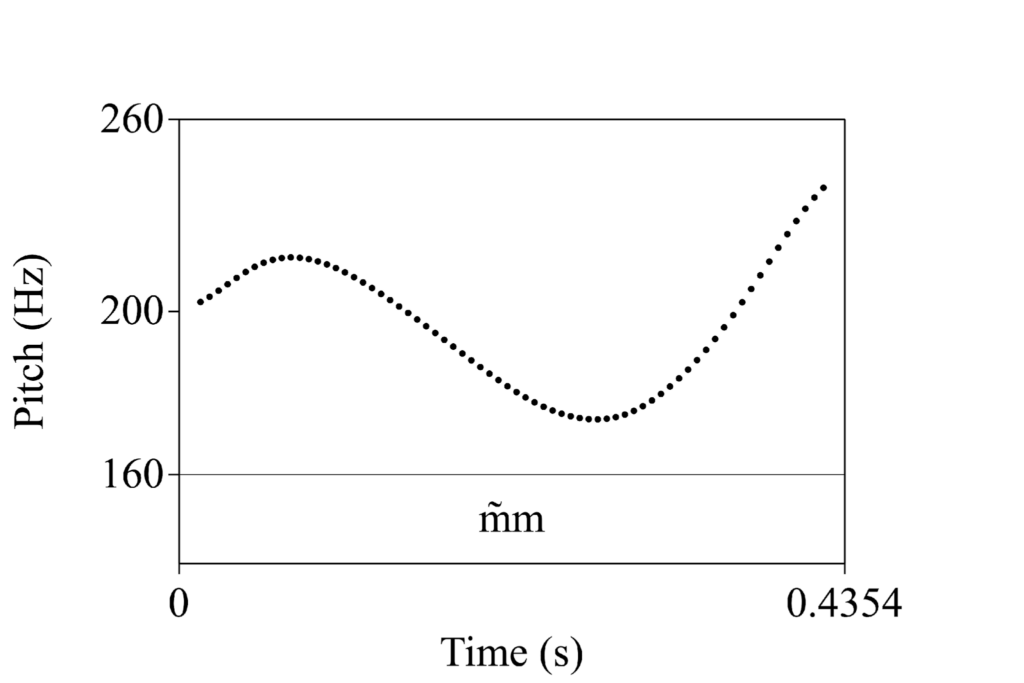
This pitch wave is known in the phonology of Norwegian as the East Norwegian ‘second tonal accent’ (see Kristoffersen, 2000). In Norwegian, every intonation phrase is pronounced with either the ‘first’ or the ‘second’ tonal accent, and the wave form of this m᷉m will be easily noticeable by participants as the latter. Despite often being confounded with mhm in transcriptions in Norwegian, recent and ongoing research by one of the authors suggests language-/culture-specific routinizations of their forms and actions. These routinizations appear to be largely carried forward and reproduced by the multilingual participants in our data.
In our exploration of multilingual interactions, we understand multilingualism as embedded in the participants’ holistic use of available interactional resources – linguistic, vocal, corporal, material – for making social actions recognizable for each other. Using such resources for doing certain actions can be routinized into social practices (Garfinkel, 1967; Schegloff, 1997; Schmidt and Deppermann, 2023) and can combine elements from different (language-/culture-specific) routinizations into locally emerged multilingual practices. In such multilingual practices, we understand participants as recipient designing their turns orienting to shared linguistic repertoires and still largely accommodating language-/culture-specific routinizations.
Our aims align with Auer’s (2022) in seeking to empirically interrogate and give nuance to current, unitary strands of translanguaging theory (like Otheguy, García & Reid, 2019), while recognizing social affordances of certain translanguaging pedagogies (cf. García & Sarroub, 2025:81). For both pedagogy and research, we are also informed and inspired by longitudinal conversation-analytic work on interactional competence in second languages (see, e.g., Skogmyr Marian & Pekarek Doehler, 2025).
- Mhm and m᷉m in one multilingual family’s dinners
The multilingual families in our data use linguistic resources from German-English-Swedish, Norwegian-German and Norwegian-English (see Schulz-Budick, 2025). In this squib, we will focus on the latter family, consisting for our present purposes of mother and daughter. This family lives in Norway and uses Norwegian and English at home on a daily basis, while having resources from several other languages in their repertoires (reported in interviews but unspecified here for purposes of anonymization). From their three recordings lasting, respectively, 33 minutes, 35 minutes and 52 minutes, we present two extracts below.
In contrast with the other families in the data set, the mother and daughter explicitly decide in each of their three recordings which language to use (for a discussion of family language policies, see Bloch 2024). Once the language has been decided, the participants largely adhere to these decisions throughout the recordings. Accommodating the language decided on, their adherence to language-/culture-specific routinizations appear to hold true down to the level of response particle phonology, as represented by the extracts below (transcribed according to Jefferson, 2004, and Mondada, 2014, 2024, adapted).
In extract 1, the daughter (Kid) works in line 1-2 to establish a common reference on a certain TV series, in what is later analyzable as a pre-announcement (Terasaki, 1976/2004). The mother (Mom), meanwhile, bites into a pizza slice before responding with our focal phenomenon mhm in line 3:
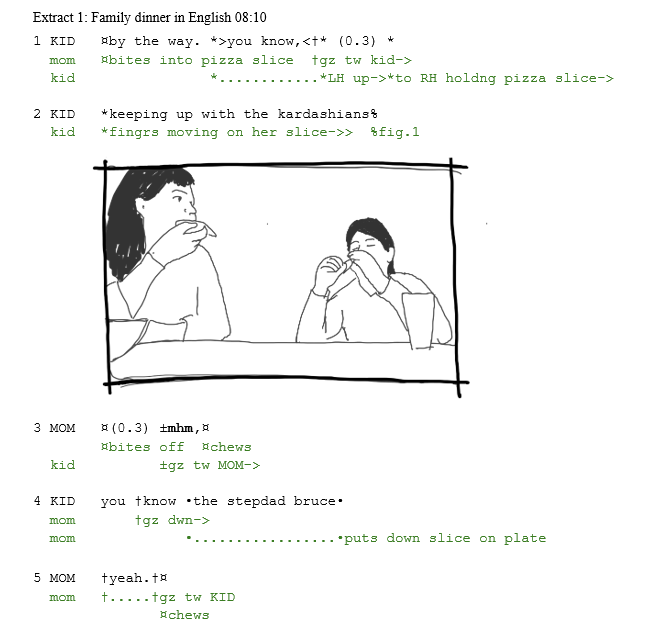
The daughter treats this mhm as a confirmation and/or go-ahead by, in line 4, immediately moving on to another, more specific person reference within that domain. Our interest here is the mother’s choice of particle in her locally situated design oriented towards talk in English, as tentatively representative of a majority of such cases noticed in the data (ongoing collecting and analysis), and in contrast to designs oriented to talk in Norwegian as represented by extract 2 below.
In extract 2, the mother provides a temporal locator (cf. Jefferson, 1978:222) contrasting her experience from prior talk by emphasizing eg ‘I’ (line 1), and does an assertion about certain languages on TV (line 2). To this, her daughter responds with our focal phenomenon m᷉m in line 3:
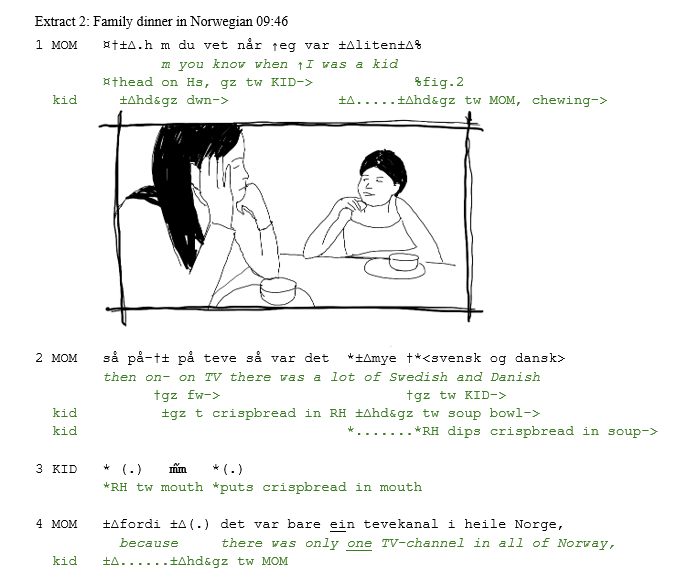
We see the daughter’s m᷉m in this position as ambivalent: It could acknowledge her mother’s assertion and/or treat the mother’s turn as incomplete and as having projected continuation into further talk (for clearer action clusters of m᷉m, see Sbertoli-Nielsen, 2023, 2025b). After a microsilence while the daughter puts crispbread in her mouth, the mother does another turn-constructional unit in line 4, moving into what seems to develop (after the extract) as ambivalent between an account and a telling.
Again, our interest is the daughter’s choice of particle in her locally situated design, here an m᷉m oriented towards talk in Norwegian. This particle too is tentatively representative of a majority of such cases noticed in the data, used when the participants speak Norwegian but not when speaking English. We see these designs as phonologically sensitive, granular accommodations to the language of their sequential environments.
- Ongoing directions
Observing the aforementioned data from multilingual families, we are in the process of making collections (cf. Clift & Raymond, 2018) of mhm and m᷉m, and analyzing them in their local situatedness. Our impression so far is – as we have tentatively suggested here – that there are systematicities in their designs vis-à-vis the language used in their sequential environments. We find such potential systematicity especially interesting as a starting point for CA/IL-based, empirical interrogations of the elsewhere influential unitary translanguaging theory (Otheguy, Garcia & Reid, 2019), from which one might infer that such particles would float somewhat freely across multilingual practices. Since these particle practices are more often acquired ‘in the wild’ than from normative, educational institutions, documenting them as relatively orderly and language-/culture-specifically routinized may strengthen the perspective put forth by Auer (2022: 127) that ‘languages’ are socially constructed not only by linguistic authorities but by multilingual speakers themselves. For our ongoing work in this direction, we would appreciate any helpful comments and suggestions from members of the ISCA community.
References
Auer. P. (2022). ‘Translanguaging’or ‘doing languages’? Multilingual practices and the notion of ‘codes’. In MacSwan (Ed.) Multilingual Perspectives on Translanguaging.
Multilingual Matters.
Betz, E., Deppermann, A., Mondada, L., & Sorjonen, M.-L. (Eds., 2021). OKAY across languages: Toward a comparative approach to its use in talk-in-interaction. John Benjamins.
Bloch, G. (2024). Language ideologies in transnational families with Israeli background in Finland. Frontiers in sociology, 9. https://doi.org/10.3389/fsoc.2024.1453226
Boersma, P., & Weenink, D. (2023). Praat: Doing phonetics by computer (Version Retrieved 1 May 2023 from http://www.praat.org/) [Computer software].
Clift, R. & Raymond, C. W. (2018). Actions in practice: On details in collections. Discourse Studies 20(1), pp. 90–119. Sage Journals.
Dingemanse, M., Liesenfeld, A., & Woensdregt, M. (2022). Convergent Cultural Evolution of Continuers (mmhm). The Evolution of Language: Proceedings of the Joint Conference on Language Evolution (JCoLE), 61–67.
García, O. & Sarroub, L. K. (2025). Beyond Puntos y Rayas: Translanguaging Pedagogy for Language Minoritized Students. Literacy Research: Theory, Method and Practice 74(1),
pp. 76–91. Sage Publications.
Gardner, R. (2001). When Listeners Talk: Response tokens and listener stance (Vol. 92).
John Benjamins. https://doi.org/10.1075/pbns.92
Garfinkel, H. (1967). Studies in ethnomethodology. Prentice-Hall.
Goodwin, C. (1986). Between and within: Alternative sequential treatments of continuers and assessments. Human Studies, 9(2–3), 205–217.
Günthner, S. (1993). German-Chinese interactions. Differences in contextualization conventions and resulting miscommunication. Pragmatics 3(3), pp. 283–304. John Benjamins.
Jefferson, G. (1978). Sequential Aspects of Storytelling in Conversation. In J. Schenkein (Ed.) Studies in the Organization of Conversational Interaction. Academic Press.
Jefferson, G. (1985). Notes on a Systematic Deployment of the Ackowledgement Tokens Yeah and Mm hm. Papers in Linguistics, 17, 197–216.
Jefferson, G. (2004). Glossary of transcript symbols with an introduction. In Conversation analysis: Studies from the first generation, ed. Gene Lerner (pp. 43–59). Benjamins.
Kristoffersen, G. (2000). The phonology of Norwegian. Oxford University Press.
Mandelbaum, J. (2012). Storytelling in conversation. In T. Stivers & J. Sidnell (Eds.), The handbook of Conversation Analysis (pp. 492–507). Wiley-Blackwell.
Mondada, L. (2014). The local constitution of multimodal resources for social interaction. Journal of Pragmatics, 65, 137–156. https://doi.org/10.1016/j.pragma.2014.04.004
Mondada, L. (2024). Multimodal transcription conventions. In J. D. Robinson, R. Clift, K. H. Kendrick, & C. W. Raymond (Eds.), The Cambridge Handbook of Methods in Conversation Analysis. Cambridge University Press.
Otheguy, R., García, O. & Reid, W. (2019). A translanguaging view of the linguistic system of bilinguals. Applied Linguistics Review 10(4), pp. 625-651. De Gruyter Mouton.
Sacks, H. (with Jefferson, G., & Schegloff, E. A.). (1992a). Lectures on conversation: 1 (Vol. 1). Blackwell.
Sacks, H. (with Jefferson, G., & Schegloff, E. A.). (1992b). Lectures on conversation: 2 (Vol. 2). Blackwell.
Sbertoli-Nielsen, P. (2023). Teasing Out 2mm: Bilabial-Nasal Response Particles in Norwegian. Norsk Lingvistisk Tidsskrift, 41(2), Article 2. https://ojs.novus.no/index.php/NLT/article/view/2265
Sbertoli-Nielsen, P. (2025a). Multimodally aligning with projected continuation in Peninsular Spanish. Interactional Linguistics, John Benjamins. https://doi.org/10.1075/il.24017.sbe
Sbertoli-Nielsen, P. (2025b). How do we do listening across languages and cultures? Structurally aligning with projected continuation in Norwegian and in Peninsular Spanish [Doctoral thesis, available in ResearchGate]. University of Oslo.
Schegloff, E. A. (1982). Discourse as an interactional achievement: Some uses of ‘uh huh’and other things that come between sentences. Analyzing Discourse: Text and Talk, 71, 71–93.
Schegloff, E. A. (1997). Practices and actions: Boundary cases of other-initiated repair.
Discourse Processes 23(3), pp. 499–545. Routledge.
Schmidt, A. and Deppermann, A. (2023). On the Emergence of Routines: An Interactional Micro-history of Rehearsing a Scene. Human Studies 46(2), pp. 273–302. Springer.
Schulz-Budick, D. (2022). Multilingual interactions at the family dinner table [unpublished dataset].
Schulz-Budick, D. (2025). Sprachwissenschaftliche Analysen und Beobachtungen plurilingualer Gespräche am familiären Esstisch. Peter Lang. https://www.peterlang.com/document/1502743
Skogmyr Marian, K. & Pekarek Doehler (2025). Becoming a member in social worlds: The interface of learning and socialization in L2 interactions. Language, Interaction and Acquisition 16(1), pp. 1–18. John Benjamins. https://doi.org/10.1075/lia.00027.sko
Stivers, T. (2008). Stance, Alignment, and Affiliation During Storytelling: When Nodding Is a Token of Affiliation. Research on Language & Social Interaction, 41(1), 31–57. Taylor & Francis. https://doi.org/10.1080/08351810701691123
Terasaki, A. K. (1976/2004). Pre-announcement sequences in conversation. In G. H. Lerner (Ed.), Conversation Analysis: Studies from the first generation (pp. 171–223). John Benjamins Publishing Company. https://doi.org/10.1075/pbns.125.11ter (first appeared as Social Science Working Paper 99, School of Social Sciences, Irvine, CA, 1976.)
Zama, A., & Robinson, J. D. (2016). A Relevance Rule Organizing Responsive Behavior During One Type of Institutional Extended Telling. Research on Language and Social Interaction, 49(3), 220–237. https://doi.org/10.1080/08351813.2016.1196551