
Andrea Rodriguez, The University of Queensland
Introduction
The moment-by-moment accomplishment of intimate adult relationships involves the speakers’ implicit management of complex, unspoken socio-relational expectations. Drawing on CA, various studies have offered insights that aid the procedural unpacking of this rich socio-relational substrate to which participants visibly orient when designing (Sacks et al., 1974) and ascribing social actions (Levinson, 2013; Deppermann & Haugh, 2021). Key findings have focused on how interlocutors co-construct and negotiate their expectations and relative stances vis-à-vis various domains of the moral order, including epistemic (Raymond & Heritage, 2006; Stivers et al., 2011; Rodriguez & Sinkeviciute, 2025), deontic (Stevanovic & Peräkylä, 2012; Stevanovic, 2015), affective (Robles & Wetherall, 2021; Kim & Carlin, 2025; Liu, 2026), and benefactive (Clayman & Heritage, 2014; Baxter-Webb, 2024, 2025) rights and obligations.
Building on Baxter-Webb’s (2025) conceptualisation of the ‘benefactive order’ and my PhD research, this paper examines how Spanish-speaking adult family members negotiate their relational expectations and entitlements to (a) receive/grant/provide/accept/reject something beneficial and (b) decide what counts as beneficial. More specifically, the analysis focuses on the role that practices of holding others accountable play in surfacing the interlocutors’ orientation to inferable relational expectations (Rodriguez, 2026a, 2026b), thereby engaging in a complex dialectic of care and control (see Goodwin & Cekaite, 2018). In exploring what the reflexive nature of accounting practices (Garfinkel, 1967) can reveal about delicate actions, such as refusing to grant a benefit and rejecting the benefits of unsolicited advice (Shaw & Hepburn, 2013; Shaw et al., 2015), the analysis presents CA-informed insights into the micropolitics of intimate relationships. That is, the situated ‘value’ that interlocutors attribute to actions depending on the configuration of contextual contingencies, as evidenced by the manoeuvres they engage in to implement or avoid those actions (Drew, 2022).
Data
The analysis draws on an eight-hour collection of naturally occurring interactions among adult Spanish-speaking members of two transnational families over Zoom. The set of consecutive multiparty conversations collected in 2023 includes 4-5 members per family, who maintain close relationships through one-hour weekly video calls. In each family, two members were Colombian married couples living in Australia, and the others (parents, siblings, and aunt) were located in different countries (Germany and Colombia). The following two extracts were selected from the collection of 100 sequences displaying practices of holding self and other accountable for breaches of relational expectations, which informed my PhD research project.
Analysis
The following examples show how the members’ divergent evaluations of what is beneficial (e.g., maintaining good health vs satisfying a craving) trigger negotiations of the moral-relational entitlement to do ‘caring’ for loved ones. In Extract 1, Gabriela implicitly refuses to indulge her older sister, Paulina, in her craving for candy by holding her accountable for wanting more. Right before this fragment, Paulina’s daughter had left the conversation momentarily to pick up a Kit-Kat that she wanted to share with her husband. We join the conversation as Paulina expresses her desire for one as well.
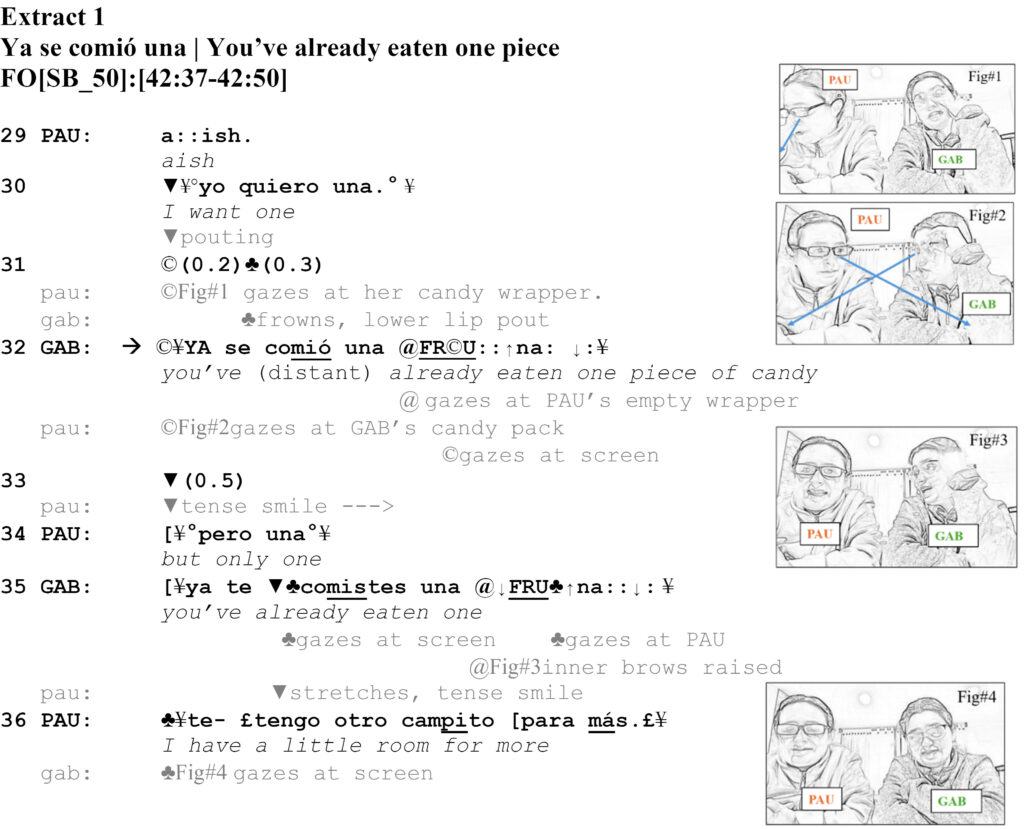
The extract begins with Paulina expressing disappointment through the interjection “aish”, characterised by breathy phonation, weaker articulatory force and falling pitch (Couper-Kuhlen, 2009). While her declarative “yo quiero una” (“I want one”) in line 30 is designed as an ostensive request directed at her daughter, its infelicitous quality due to the constraints of transnational distance makes another potential benefactor relevant. During the 0.5s of silence in line 31, Paulina gazes at her empty candy wrapper (Fig. 1) and turns toward the spot where Gabriela has her pack of taffy (Fig. 2). In doing so, Paulina casts her physically co-present younger sister as a potential candidate, orienting to Gabriela not only as the owner of resources for a conditionally relevant granting but also as a former benefactor who offered her a taffy piece earlier in the call. Nonetheless, Paulina’s embodied ‘hinting’ treats the incipient request as better left unsaid (Haugh, 2017), thereby indexing her lower degree of entitlement relative to Gabriela’s deontic authority over her candy.
Gabriela, who had accused Paulina of finishing an entire taffy box on her own earlier in the conversation (data not shown), responds with a negative embodied assessment (Fig. 2), gazing at Paulina’s empty candy wrapper, furrowing her brow, and pouting her lower lip (Li, 2021). In line 32, her factual declarative “ya se comió una Fruna” (“you have already eaten one piece of candy”) implements a ‘composite action’ (Rossi, 2018) consisting of both an account for her implied refusal to offer Paulina the treat and implied criticism, holding her older sister accountable for expecting more candy. Gabriela’s turn design marks Paulina’s expectation of another offer as inapposite in three ways. The adverb “ya” (“already”) foregrounds Gabriela’s earlier granting of the benefit, implying that a second granting is unnecessary. The clitic “se” which marks perfective aspect, intensifies Paulina’s agency, highlighting that she has eaten the entire candy and thus inviting self-control. More importantly, the quantifier that delimits the noun phrase “una Fruna” (“one piece of candy”) marks Gabiela’s stance regarding what should count as sufficient for Paulina. In this way, Gabriela seemingly downplays her potential entitlement as the candy owner while foregrounding the relevance of doing ‘caring’ for her older sister’s health by claiming a degree of entitlement to decide how much candy is beneficial for her. Nonetheless, in holding her older sister accountable, Gabriela also orients to Paulina’s superior deontic stance, appealing to her expected agency in exercising self-control over her cravings.
The sensitivity of this underlying negotiation of socio-relational entitlements and responsibilities is prosodically marked by child-like delivery with higher pitch, intentional grammar errors “te comistes” (close “you”) (see Pichler, 2017). Within this playful frame, Paulina’s retort after the 0.5s in line 33 “pero una” (“but only one”) triggers a pursuit from Gabriela, this time in the form of a complaint with inner brows raised and a sudden drop of her hand (Fig. 3) to which Paulina responds with an open-mouthed smile. After stretching out, Paulina’s final account “tengo campito pasa más” (“I have a little room for more”) in line 36 foregrounds her physical capacity to eat more. In so doing, she claims deontic independence to decide what counts as beneficial for herself and resists the relevance of Gabriela’s invitation to self-control as a form of “care”. Gabriela’s disapproval of Paulina’s account is evident as she shifts her gaze toward the screen, her brows raised and lips tense (Fig. 4). This marks the end of the sequence where Paulina’s expectation of granting is not fulfilled.
In Extract 2, Ron offers unsolicited advice to his wife’s aunt, Gabriela, thereby implicitly claiming entitlement to comment on what is (not) beneficial for her. Prior to this segment, Gabriela had expressed her strong personal preference for wearing high heels at work, prompting Ron’s warning in line 1.
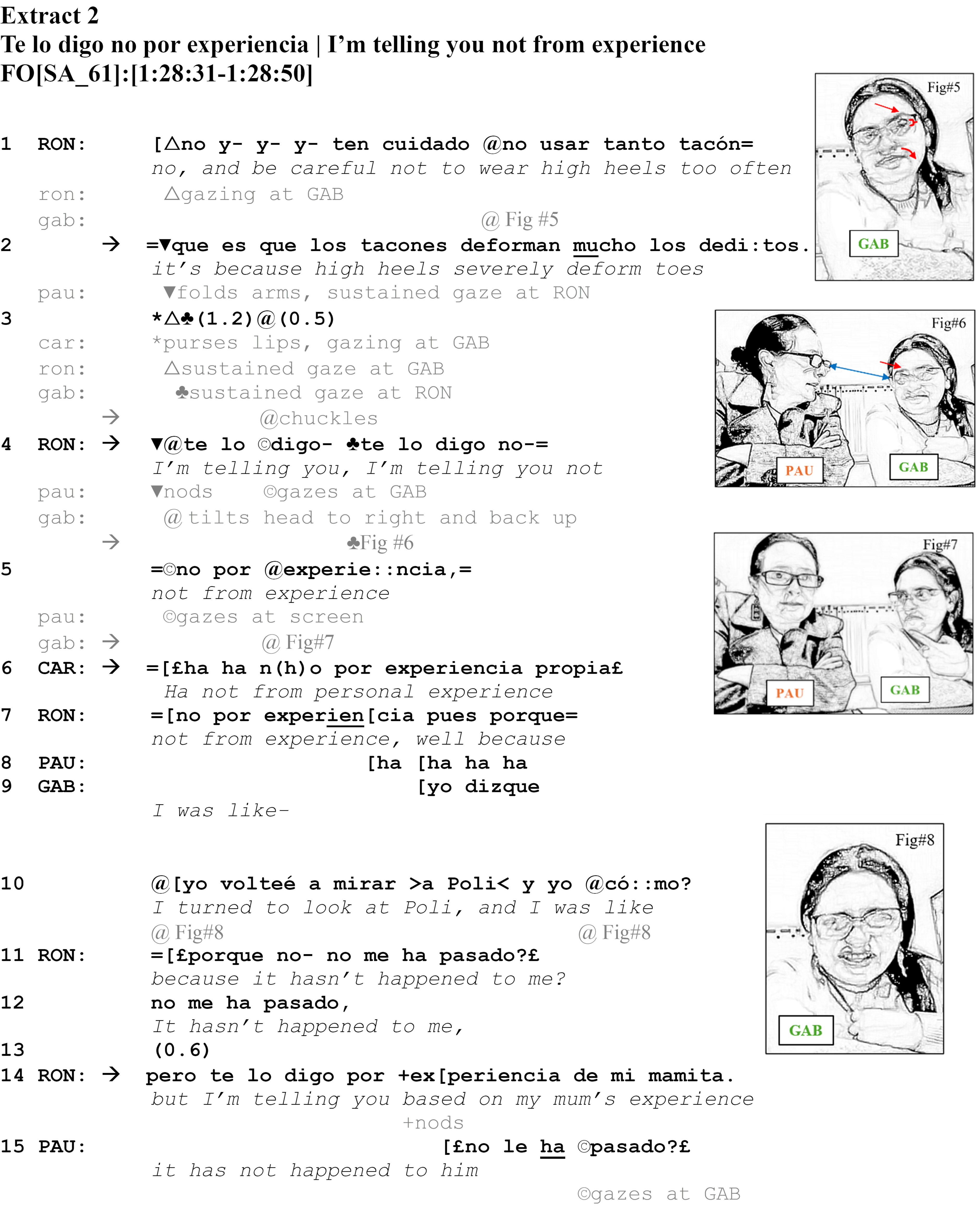
In this fragment, Ron’s overlapping turn in line 1, urging Gabriela to “be careful not to wear high heels too often”, is constructed as a sensitive form of doing ‘caring’ through careful modulation of his deontic stance. Ron’s persuasive action shifts from the imperative “ten cuidado” (“[you] be careful”), conjugated for the informal/close second person “tú”, to the impersonal infinitive “no usar” (“not to wear”). While the imperative indexes compliance as the expected response, claiming stronger deontic entitlement (see Couper-Kuhlen & Thomson, 2022), the impersonal infinitive backgrounds the recipient’s expected agency. In this way, Ron slightly mitigates his deontic authority to decide what counts as beneficial for Gabriela, orienting to her right to accept/reject his advice. In warranting this sensitive action, Ron also proffers a legitimising account “high heels severely deform toes” introduced by the turn-initial “que es que” (“it’s because”), which marks its requiredness in line 2. This account is imbued with affectivity through the diminutive suffix ‘ito’ in “deditos” (“little toes”), which not only softens the potential face-threatening effect of his unsolicited advice but also fosters relational connection by framing the action as an ostensive expression of concern that will benefit Gabriela. More importantly, Ron’s account invokes knowledge asymmetry (Shaw & Hepburn, 2013), sensitively positioning him as someone who knows more about the consequences of wearing high heels than Gabriela.
In response, Gabriela resists the action through various non-verbal resources. She first displays an embodied negative assessment in line 1, marked by a tense corner of her mouth, narrowed eyes, and a subtle frown with lowered inner brows and one outer brow raised (Fig. 5). In lines 3-4, she also implies disagreement by withholding a response (Drew, 2013) while sustaining her gaze at Ron for 1.2s. Her oppositional stance becomes more explicit as she adopts an embodied ironic stance, releasing a repressed chuckle, with lowered upper eyelids and a mouth pressed against her lip, and shows further embodied resistance with a quick head tilt. This prompts Ron to launch a new account in line 4 “I’m telling you (because)”, which reflexively problematises his entitlement to proffer advice by presenting a warrant for it. Orienting to this, Gabriela exploits the accountability of Ron’s claimed epistemic authority regarding high heels, treating his account as a category-implicative action. That is, she foregrounds Ron’s inferable membership in the “high-heel wearer” category, which would grant him first-hand knowledge and authority, to mock and resist his entitlement to present himself as a benefactor. Importantly, Gabriela accomplishes this without uttering a single word. In a failed attempt to recruit her sister, Paulina, through gaze, raised eyebrows, and pursed lips (Fig. 6), she hints at the teasable inference. Then, through a mouth shrug and index finger pointing at the chin gesture (Fig. 7), she visibly constructs the source of Ron’s knowledge as questionable, thereby shifting the attention toward Ron without engaging in overt verbal repair (see Mandelbaum, 2016) or disagreement.
Ron’s and Carolina’s accounts, “not from personal experience” in lines 5-7, articulate and block the potential accountable matter. By denying Ron’s membership in the category ‘high heel wearer’, the account surfaces the inferable unconventional simultaneous membership in the categories ‘male’ and ‘high heel wearer’ as problematic. Gabriela’s tease is then verbalised in line 10 with the ‘pretence marker’ “dizque” which pre-empts the verbal report of her prior embodied response as potentially unexpected (see Olbertz, 2022) and non-serious, given her knowledge of Ron. In constructing “being confused” through nose shrugs (Fig. 8) and pretending that Ron was self-disclosing hidden habits, Gabriela mocks his account, exploiting his latent membership in the ‘high heel wearer’ category as unexpected new information. In line 11, Ron co-constructs the jocular frame furthering his account with smile voice and using the present perfect construction “porque no me ha pasado” (“because it hasn’t happened to me”), thereby rejecting the first-hand experience of deformed toes, but not explicitly denying membership in the ‘high heel wearer’ category. Finally, in line 12, Ron resumes the serious frame clarifying that his epistemic primacy comes from witnessing the consequences that his mother experienced rather than his own. In invoking the relational category ‘mother-son’, Ron legitimises his epistemic and relational right to determine what is beneficial for Gabriela as a relational responsibility of “doing caring” for one’s family.
Concluding remarks
The extracts presented above offer evidence of the complex management of the care-and-control dialectic among Spanish-speaking adult family members from a CA perspective. Caring for someone involves not only pre-empting or attending to their needs by granting a benefit but also claiming the right to grant, control, and decide what counts as beneficial for the cared-for (see Baxter-Webb, 2025). With a focus on negotiations of the entitlement to decide what counts as beneficial for loved ones, the analysis suggests that practices of holding ‘other’ accountable can be sequentially deployed to implicitly (1) challenge divergent evaluations of what counts as beneficial and (2) reject an action produced ostensively in the benefit of the recipient by delegitimising the status of the benefactor. Unlike research involving parent-child interactions, where parents’ entitlement to make decisions about what is beneficial can be taken for granted, in intimate adult relationships, much implicit negotiation seems to be necessary. The sensitivity involved in managing aspects of the benefactive order in adult family talk is evident in the degree of implicitness with which the holding ‘other’ accountable is accomplished as well as resources such as child-like delivery and the embodied mockery that mark degrees of non-seriousness as tools for implementing these sensitive social actions. Much remains to be explored regarding the linguistic affordances of Spanish to mitigate entitlements, for example, by modulating the benefactors’ agency through morphological marking. These resources offer insights into the members’ construction and navigation of a micropolitics of intimacy, particularly through the sequential negotiation of their entitlements to decide what constitutes a benefit for loved ones, thereby engaging in ‘caring’.
References
Baxter-Webb, I. (2024). A closer look at refusers’ counters: Benefactive changes, design constraints, and interpersonal implications. Journal of Pragmatics, 220, 20–32. https://doi.org/10.1016/j.pragma.2023.11.011
Baxter-Webb, I. (2025). Calculating costs or weighing social relations? The basis of the “benefactive order” in interaction. Research on Language and Social Interaction, 58(1), 69–84. https://doi.org/10.1080/08351813.2025.2450995
Clayman, S. E., & Heritage, J. (2014). Benefactors and beneficiaries: Benefactive status and stance in the management of offers and requests. In P. Drew & E. Couper-Kuhlen (Eds.), Requesting in Social Interaction (pp. 55–86). John Benjamins. https://doi.org/10.1075/slsi.26.03cla
Couper-Kuhlen, E. (2009). A sequential approach to affect: The case of ‘disappointment’. In J. Lindström, M. Laakso, & M. Haakana (Eds.), Talk in interaction: Comparative dimensions (pp. 94–123). Finnish Literature Society.
Couper-Kuhlen, E., & Thompson, S. A. (2022). Action ascription and deonticity in everyday advice-giving sequences. In M. Haugh & A. Deppermann (Eds.), Action Ascription in Interaction (pp. 183–207). Cambridge University Press. https://doi.org/10.1017/9781108673419.010
Deppermann, A., & Haugh, M. (2022). Action ascription in interaction. Cambridge University Press. https://doi.org/10.1017/9781108673419
Drew, P. (2013). Turn design. In J. Sidnell & T. Stivers (Eds.), The Handbook of Conversation Analysis (pp. 131–149). Wiley-Blackwell.
Drew, P. (2022). The micro-politics of social action. In A. Deppermann & M. Haugh (Eds.) Action Ascription in Interaction (pp. 57–80). Cambridge University Press.
Garfinkel, H. (1967). Studies in ethnomethodology. Prentice-Hall.
Goodwin, M. H., & Cekaite, A. (2018). Embodied family choreography: Practices of control, care, and mundane creativity. Routledge. https://doi.org/10.4324/9781315207773
Haugh, M. (2017). Prompting offers of assistance in interaction. Pragmatics and Society, 8(2), 183–207. https://doi.org/10.1075/ps.8.2.02hau
Kim, Y., & Carlin, A. P. (2025). Emotion displays in “moments of conflict” in parent-child interaction. Text & Talk, 45(6), 749–774. https://doi.org/10.1515/text-2023-0229
Levinson, S. (2013). Action formation and ascription. In J. Sidnell & T. Stivers (Eds.), The Handbook of Conversation Analysis (pp. 103-130). John Wiley & Sons.
Li, X. (2021). Multimodal practices for negative assessments as delicate matters: Incomplete syntax, facial expressions, and head movements. Open Linguistics, 7(1), 549–568. https://doi.org/10.1515/opli-2020-0164
Liu, Z. (2026). Displaying entitlement in sister talk: Invoking affection and third-party authority in guan sequences. Discourse Studies 28(4). https://doi.org/10.1177/14614456251396491
Mandelbaum, J. (2014). How to do things with requests: Request sequences at the family dinner table. In P. Drew & E. Couper-Kuhlen (Eds.), Requesting in Social Interaction (Vol. 26, pp. 215–242). John Benjamins Publishing Company. https://doi.org/10.1075/slsi.26.09man
Olbertz, H. (2022). American Spanish dizque from a Functional Discourse Grammar perspective. Open Linguistics, 8(1), 721–744. https://doi.org/10.1515/opli-2022-0214
Pichler, P. (2017). ‘You are stupid, you are cupid’: Playful polyphony as a resource for affectionate expression in the talk of a young London couple. Gender and Language, 11(2), 153–175. https://doi.org/10.1558/genl.25586
Raymond, G., & Heritage, J. (2006). The epistemics of social relations: Owning grandchildren. Language in Society, 35(5), 677–705. https://doi.org/10.1017/S0047404506060325
Robles, J. S., & Weatherall, A. (2021). How Emotions Are Made in Talk. John Benjamins Publishing Company.
Rodriguez, A. (2026). “Está difícil” [“It’s difficult”]: Accounting practices and the surfacing of relational expectations in transnational family talk. Discourse Studies, 28(4). https://doi.org/10.1177/14614456251396404
Rodriguez, A., & Sinkeviciute, V. (2025). “Tú sabes lo que le pasa a él?”: the Role of (Relational) Epistemics in Indirect Complaint Sequences in Spanish and English Family Talk. Contrastive Pragmatics, 6(1), 253–296. https://doi.org/10.1163/26660393-bja10098
Rossi, G. (2018). Composite social actions: The case of factual declaratives in everyday interaction. Research on Language and Social Interaction, 51(4), 379–397. https://doi.org/10.1080/08351813.2018.1524562
Sacks, H., Schegloff, E. A. & Jefferson, G. (1974). A simplest systematics for the organization of turn-taking for conversation. Language, 50(4), 696–735.
Shaw, C., & Hepburn, A. (2013). Managing the moral implications of advice in informal interaction. Research on Language and Social Interaction, 46(4), 344–362. https://doi.org/10.1080/08351813.2013.839095
Stevanovic, M. (2015). Displays of uncertainty and proximal deontic claims: The case of proposal sequences. Journal of Pragmatics, 78(Mar), 84–97. https://doi.org/10.1016/j.pragma.2014.12.002
Stevanovic, M., & Peräkylä, A. (2012). Deontic authority in interaction: The right to announce, propose, and decide. Research on Language and Social Interaction, 45(3), 297–321. https://doi.org/10.1080/08351813.2012.699260
Stivers, T., Mondada, L., & Steensig, J. (2011). The morality of knowledge in conversation. Cambridge University Press.